Enterprise deployment
Moves AI from technical concept to production-ready customer adoption across complex enterprise environments.
Dr Ming Kong
Enterprise Applied AI Leader | Agentic AI Architect | Customer Engineering
I am Ming Kong, an enterprise Applied AI leader and hands-on architect. I design and deploy AI systems that can investigate, reason, use tools, review and correct their work, while preserving evidence, human judgement and production controls.
My work spans production multi-agent systems, enterprise knowledge agents and controlled agentic architectures across Google Cloud, AWS and Azure.
The future of enterprise AI is not another chatbot. It is trustworthy digital workers operating inside better systems for controlled delegation.
How I separate workflows from digital workers
Workflows still matter. I use controlled digital workers when the work must investigate, revisit and prove its reasoning.
Workflow automation
Best for known processes with predefined steps.
Controlled digital worker
Useful when work requires investigation, evidence and review.
Why I'm building this
Working across enterprise delivery, entrepreneurship and early-stage AI investing has convinced me that the hardest AI problem is no longer access to capable models. It is building systems that organisations can trust, govern and adopt.
After years of deploying enterprise AI, I became increasingly convinced that simply adding LLMs to existing workflows was not enough. I wanted to explore systems that could investigate, challenge assumptions, use evidence and correct their work—while remaining safe under human governance.
That means bounded autonomy, review loops, approval gates and controlled release, not open-ended automation.
That is the idea behind my public engineering work.
How I separate workflows from digital workers
Workflows still matter. I use controlled digital workers when the work must investigate, revisit and prove its reasoning.
Workflow automation
Best for known processes with predefined steps.
Controlled digital worker
Useful when work requires investigation, evidence and review.
About Ming
Much of today's agentic AI is still a predefined workflow with an LLM inserted into several steps. My work focuses on systems that can make bounded decisions about what to investigate next, use tools, revisit assumptions and correct errors without losing evidence, governance or human accountability.
Moves AI from technical concept to production-ready customer adoption across complex enterprise environments.
Designs multi-agent systems, tool-calling, RAG, evaluation and controlled review patterns.
Builds evidence grounding, exception handling, approval gates and release controls into autonomous systems.
Current role
Senior Manager, AI Analytics, PwC Australia
Leads enterprise AI transformation programs across telecommunications, banking, energy, insurance and retail, with a focus on customer-facing architecture, production adoption and responsible controls.
Systems
The work is organised around controlled digital workers: systems that investigate, use tools, preserve evidence, review and release through human-governed controls.
Concept flagship | Public engineering prototype
Controlled Agentic Accountant Copilot
A controlled agentic system for financial-statement preparation, designed around delegated work, investigation, tool use, review, correction and controlled release.
Problem
Financial-statement preparation is not simply a linear prompt chain. It requires source matching, judgement-sensitive review, evidence preservation, correction loops and final human accountability.
Architecture
Controls
Production flagship | Major Australian telecommunications provider
Enterprise Contact Centre AI Transformation
Led technical architecture and production deployment of a real-time agentic AI platform delivered across PwC, Google Cloud and the client.
Problem
Safety-critical customer operations required real-time vulnerability and emergency-signal detection, low-latency guidance, evaluation tooling and operational controls.
Architecture
Controls
Supporting case studies
Major Australian energy infrastructure provider
Led development of an enterprise HR knowledge assistant positioned as a reusable enterprise knowledge-agent pattern.
Architecture
Combined AWS Bedrock, Amazon Neptune, OpenSearch Serverless, RAG and Model Context Protocol with graph-based context, vector retrieval and LLM reasoning.
Control
Focused on grounding enterprise knowledge work in structured context rather than treating the assistant as a generic chatbot.
National Australian retailer
Designed an agentic ML modernisation framework for migrating fragmented legacy R and Python environments into production-grade MLOps.
Architecture
Used LangGraph, Azure ML and CI/CD across data transfer, environment standardisation, script refactoring and pipeline generation.
Control
Converted fragmented analytical assets into a repeatable modernisation framework with production-oriented delivery controls.
Public engineering prototype
Applies controlled agentic reasoning to tax-ruling research and professional judgement.
Architecture
Extends the controlled-agentic pattern into research workflows where evidence and review discipline matter.
Control
Keeps the system positioned as support for professional analysis, not a replacement for human judgement.
Principles
The point is not unrestricted autonomy. The point is controlled delegation: systems that can adapt, investigate and correct while remaining evidence-grounded and human-governed.
01
Controlled agents become useful when the system can decide what to investigate next within defined boundaries.
02
Outputs should preserve the sources, artefacts and reasoning context needed for review.
03
Skills and know-how can guide judgement, but client evidence must remain distinct.
04
Autonomous work should pass through review, exception handling and approval gates before delivery.
05
Self-correction should be structured, observable and limited by explicit controls.
06
Professional judgement, escalation and release decisions remain human-governed.
Speaking
Selected external showcases where controlled enterprise AI work has been shown through real customer delivery evidence.
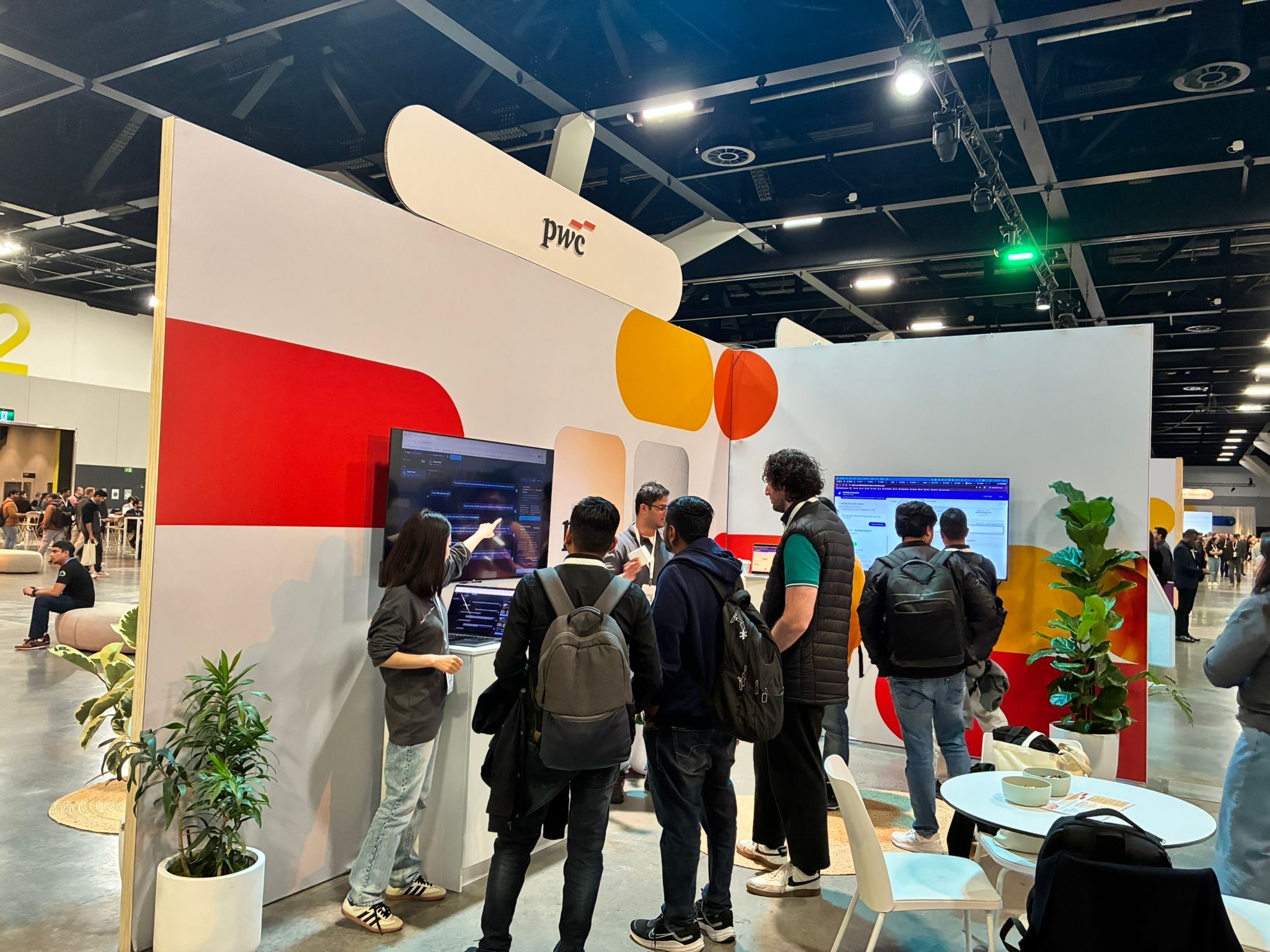
Google Summit Sydney 2026
The real-time contact centre agentic AI platform for a major Australian telecommunications provider was showcased at Google Summit Sydney 2026, with real-time detection, agent orchestration, tool-calling and production evaluation.
AWS Summit Sydney 2026
An AWS-powered contract intelligence platform for a major retail and hospitality group was showcased at AWS Summit Sydney 2026.